Food Industry Intralogistics: Constraints, Hygiene, and Technologies for High-Performance Warehouses
Summary of the article
Faced with strict traceability, hygiene, and cold chain management requirements, food industry logistics demands tailor-made solutions. Automation (AMRs, predictive maintenance) and the use of stainless-steel structures make it possible to reconcile sanitary compliance with volume growth. Management through WMS/WCS software proves indispensable for guaranteeing comprehensive product tracking “from farm to fork.” To secure these fragile flows, choosing an expert integrator with a responsive after-sales service is crucial. Transitic meets this need with concrete achievements in extreme cold and high-throughput environments, notably for Maximo and Flandr’œufs.
Table of Contents
The food industry is one of the most demanding sectors for logistics. Controlled temperatures, flawless traceability, and impeccable hygiene: here, constraints are structural and leave no room for improvisation.
Food industries invested €2.8 billion in new technologies in 2024 (source: industrie-agroalimentaire.net). The priority is therefore the modernization of intralogistics equipment in order to remain competitive and gain agility in a particularly restrictive environment.
Consequently, logistics managers must upgrade their facilities, scrupulously comply with standards, and absorb constantly growing volumes. We will explore these overlapping challenges in this article.
01. The Unique Challenges of Food Industry Intralogistics

Food industry intralogistics operates within a highly strict regulatory framework. Standards such as IFS, BRC, or ISO 22000 require flawless flow traceability, rigorous zone separation, and cleaning protocols that mandate stainless-surface equipment capable of withstanding high-pressure washing.
In addition to these sanitary imperatives, there are physical constraints related to products and environments. The cold chain subjects equipment to extreme conditions: for example, the battery life of certain systems drops significantly below zero degrees, while condensation accelerates the oxidation of mechanical and electrical systems.
Furthermore, product fragility leaves no room for repeated impacts or excessive vibrations. A poorly adjusted conveyor or an unsuited palletizer can generate breakage rates that weigh heavily on overall productivity. In the food industry, intralogistics performance is therefore measured as much by product preservation as by flow fluidity.
02. Materials and Design: Stainless Steel and Hygienic Equipment
Stainless steel has become the benchmark material in food industry intralogistics. Resistant to corrosion and compatible with chemical cleaning agents, it offers unparalleled durability in wet or cold environments.
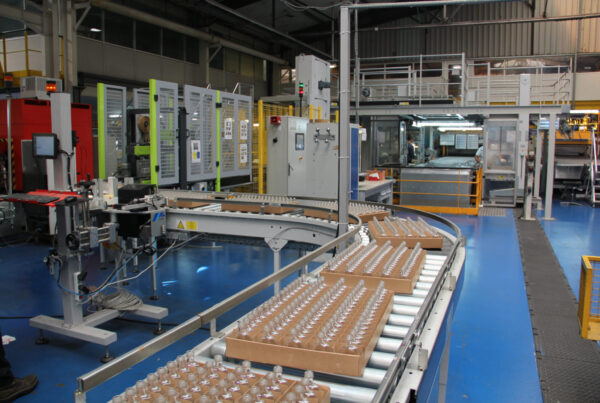
Beyond the material itself, the entire design is being rethought: conveyors are thus engineered with food-grade plastic modular belts or stainless steel rollers, and can be quickly disassembled for disinfection. Corners are rounded and joints are accessible to prevent potential bacterial harborages. As for sorting systems, they incorporate a design that absorbs thermal expansion along with water-resistant sensors.
03. Traceability and Regulatory Compliance

In the food sector, European Regulation (EC) No 178/2002 mandates full traceability “from farm to fork.” It must be possible at any given time to identify a product’s origin, its journey through the warehouse, and its final destination. This requirement for upstream and downstream transparency makes it possible, notably, to quickly isolate the affected items in the event of a product recall.
In this context, connected WMS (Warehouse Management System) and WCS (Warehouse Control System) software play a central role by managing physical flows and associated data in real time. They automatically record every stock movement, manage batch-specific shelf life and expiration dates, and control labeling as well as barcode scanning at every stage of the process.
04. New Technologies Driving Performance
Automated solutions are now making a major breakthrough in food industry intralogistics. Today, AMRs (Autonomous Mobile Robots) are capable of operating in sub-zero cold storage warehouses. Consequently, they reduce workers’ exposure to the cold while maintaining a steady pace.
In parallel, cameras placed on sorting lines or at the end of production have become full-fledged quality control tools, detecting defects in appearance, size, or labeling errors. Picking automation via robotic arms is also advancing, thanks to better-adapted grippers and algorithms capable of handling highly heterogeneous items without systematic reconfiguration.
Finally, predictive maintenance makes it possible to anticipate breakdowns before they interrupt production. This is a paramount challenge on lines where any unplanned downtime can compromise the cold chain and lead to significant product losses.
05. How to Choose Your Food Industry Intralogistics Integrator
To choose the right intralogistics integrator in the food industry, several criteria must be taken into consideration.
The first is to evaluate the provider’s level of sector expertise: have they already designed and deployed facilities in cold and/or regulated environments for products similar to yours? Remember to check their client references. The second essential criterion is the quality of the after-sales service. The integrator’s responsiveness, intervention response times, and spare parts availability must be closely examined to prevent any damaging downtime and the associated financial losses.
When discussions with a provider are underway, several questions can quickly gauge their level of maturity: how do they integrate hygiene constraints right from the design phase? What protocols do they propose for the gradual ramp-up of the facilities? Do they offer a predictive maintenance solution?
Choosing the right food industry partner means finding an expert capable of combining sanitary rigor with after-sales service reliability.
06. Transitic’s Food Industry Expertise

For several decades, Transitic has been designing tailor-made automation solutions, perfectly adapted to the constraints of the food industry. This field expertise is backed by a wide range of references:
-
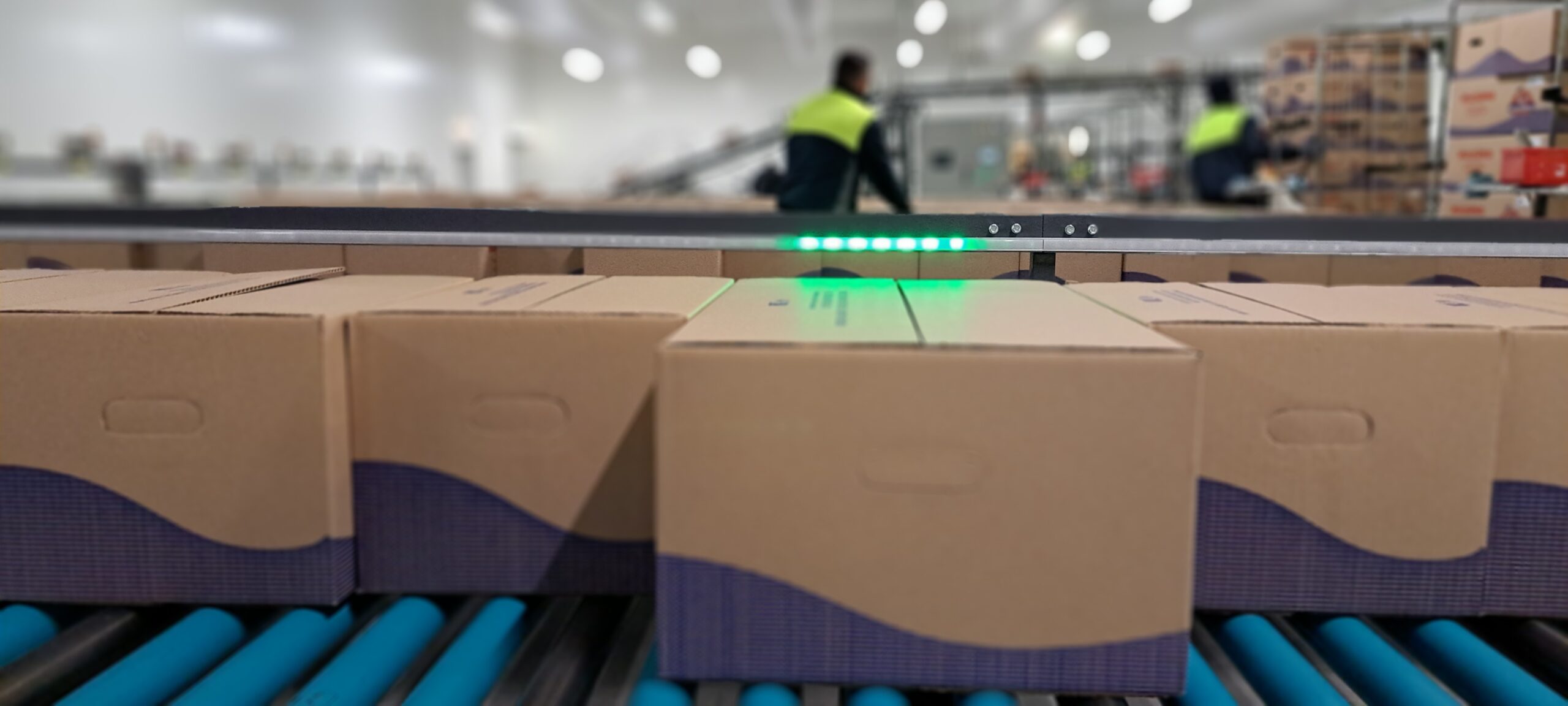
- Maximo (Home delivery specialist): Transitic deployed over 1.2 kilometers of conveyors operating in a chilled environment down to -25°C (-13°F), enabling the sorting of 1,200 parcels per hour. Right from the design phase, the teams integrated mechanical and electronic components resistant to extreme cold, as well as an overhead system that automatically evacuates 3 tons of cardboard waste per day.
-
- Flandr’œufs (Egg packing center): Transitic demonstrated its hygienic expertise through an automated stainless-steel conveyor network capable of processing 100,000 eggs per hour, per line. The fragility of the goods required the use of low-vibration belts and rollers to eliminate jolts. The site also integrates 6 automatic labeling machines and 2 end-of-line palletizing robots.
-
- Lionor & Verpom: Other industry leaders trust Transitic. For the poultry processor Lionor, a tailor-made retrofit enabled the deployment of a high-speed sorter (2,500 parcels/hour), generating a 15% increase in productivity. At potato specialist Verpom, line automation combined with OpenWCS software doubled the facility’s processing capacity while guaranteeing total traceability.
About the author – Cloé Moreel
Cloé Moreel has been a communications officer at Transitic since 2020. She regularly writes articles on intralogistics, supply chain, and emerging connected technologies.
Subscribe to our newsletter
A concentrated dose of intralogistics! Discover our latest business cases, videos, and news.
Related Articles
#connectedintralogistics
France
96 Bd du Petit Quinquin
CRT 1 – 59812 Lesquin
Tél. : +33 (0)3 20 87 66 96
Germany
Am Scheid 1
57290 Neunkirchen
Tel : +49 2735 6588580
Spain
C/ Velazquez, N. 80 – 5 IZ
28001 Madrid
Tel : +34 673 234 296