Micro-Fulfillment and Compact Warehouses: The Future of Omnichannel Logistics
Summary of the article
A Micro-Fulfillment Center (MFC) is a compact, automated urban warehouse that brings inventory closer to consumers. It meets e-commerce demands by accelerating deliveries and reducing last-mile costs. Through automation and high-density storage, it optimizes order picking within reduced footprints. The WCS coordinates equipment to guarantee high-performance logistics flows. MFCs strengthen the agility of retail and omnichannel players. Their success relies on the efficient management of inventory, replenishment, and systems.
With the ubiquity of e-commerce, last-mile performance has become a key competitive factor. Same-day deliveries, window time-slots of just a few hours, ever-more ambitious speed promises… Logistics players must succeed in balancing proximity, speed, and productivity.
The traditional model of the large logistics warehouse located on the outskirts of cities is currently showing its limitations. Situated mostly far from consumption zones, these sites struggle to meet growing responsiveness requirements while keeping transport costs under control. Therefore, how can companies bring inventory closer to consumers without suffering from skyrocketing urban real estate costs or sacrificing the operational efficiency of order picking?
It is within this context that Micro-Fulfillment Centers (MFCs) are emerging. These compact, highly automated warehouses located as close as possible to urban centers are proving to be a relevant answer to the challenges of omnichannel commerce and express delivery.
In this article, we break down this major trend and explore the automation technologies that make the deployment of these new urban logistics hubs possible.
01. What is Micro-Fulfillment and why has it become essential?
A new generation of urban warehouses
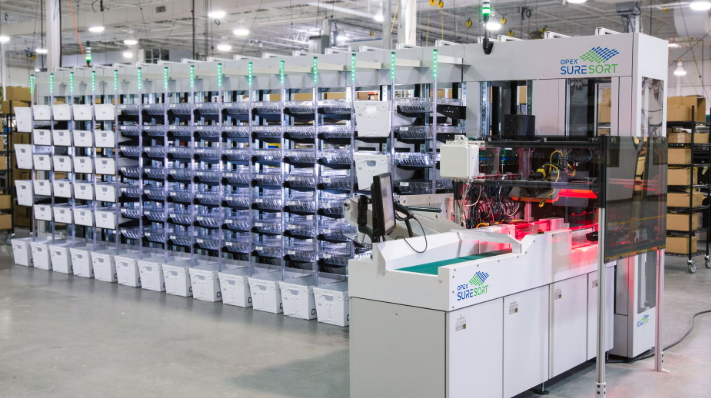
A Micro-Fulfillment Center (MFC) refers to a small-scale logistics warehouse designed to bring inventory closer to end consumers while guaranteeing fast and efficient order picking. Unlike traditional logistics platforms that can span tens of thousands of square meters, an MFC typically occupies a surface area between 500 and 3,000 m².
This compactness allows it to be established in the heart of urban centers, in strategic peri-urban areas, or even at the back of existing stores. Consequently, some brands are transforming a portion of their commercial retail space into dedicated picking areas, known as back-stores, in order to fulfill online orders more rapidly.
Why are Micro-Fulfillment Centers growing so rapidly?
The rising success of Micro-Fulfillment Centers is driven by the convergence of several underlying trends that are disrupting the entire supply chain:
The demand for immediacy
Delivery times of several days, once considered acceptable, are progressively giving way to ever-faster services. As a result, companies must move their inventory closer to consumer hubs.
Real estate pressure
This is custom heading element
The cost of the last mile
Depending on the distribution setup, it can account for up to 50% of total transport costs. Every kilometer traveled between the warehouse and the final customer directly impacts operational costs, delivery times, and the carbon footprint.
Faced with these challenges, installing compact inventory and order picking systems in the heart of cities is becoming the only way for businesses to remain profitable.
02. The strategic advantages of compact warehouses for Retail and E-commerce
Enhanced omnichannel agility
A Micro-Fulfillment Center is capable of centralizing multiple flows within a single infrastructure. E-commerce orders, store replenishment, and customer returns management can thus be processed from one and the same site. This pooling of operations simplifies processes and fosters a seamless customer experience across all sales channels.
Considerably reduced picking times
Thanks to a high level of automation, MFCs significantly accelerate order processing. 30 minutes are now enough. This responsiveness represents a major asset in meeting fast delivery and Click & Collect expectations.
Maximum productivity in a reduced footprint
Goods are brought directly to workstations via Goods-to-Person systems, allowing for increased throughput while limiting space and labor requirements.
03. Which intralogistics technologies should equip a Micro-Fulfillment Center?
La performance d’un Micro-Fulfillment Center repose avant tout sur sa capacité à automatiser les opérations. L’enjeu consiste à traiter un volume important de commandes sur une surface réduite, en optimisant à la fois l’utilisation de l’espace et la circulation des marchandises. Pour y parvenir, plusieurs technologies sont à présent disponibles :
High-density storage and Goods-to-Person
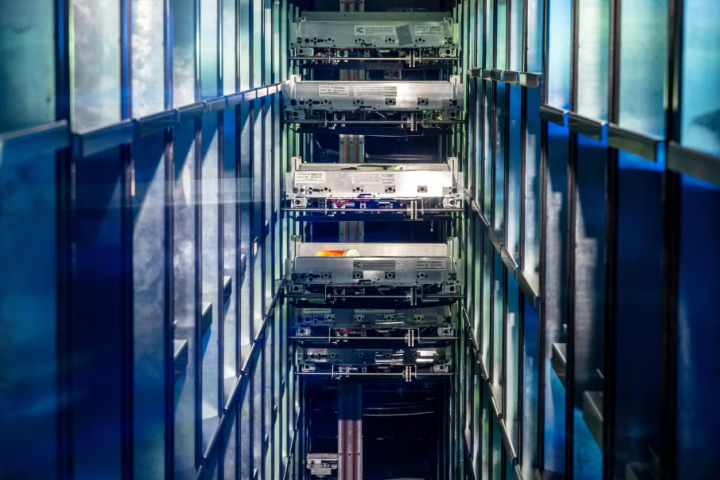
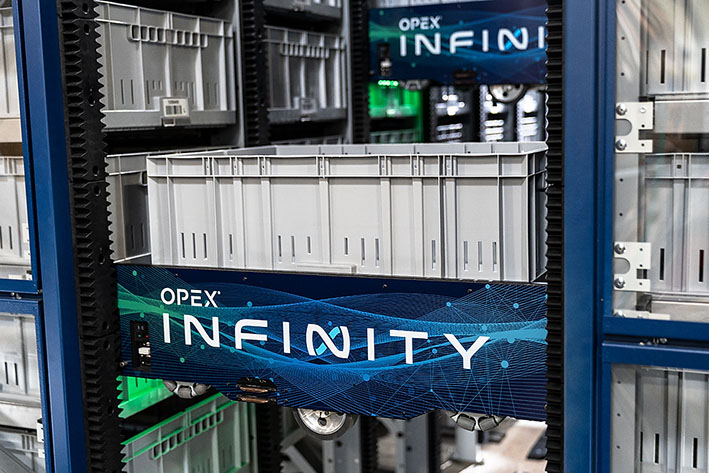
MFCs rely on automated storage and retrieval systems (AS/RS), multi-level shuttles, or cube storage systems, which fully exploit vertical ceiling height and eliminate the circulation aisles normally required for manual picking.
Sorting systems and modular conveyors
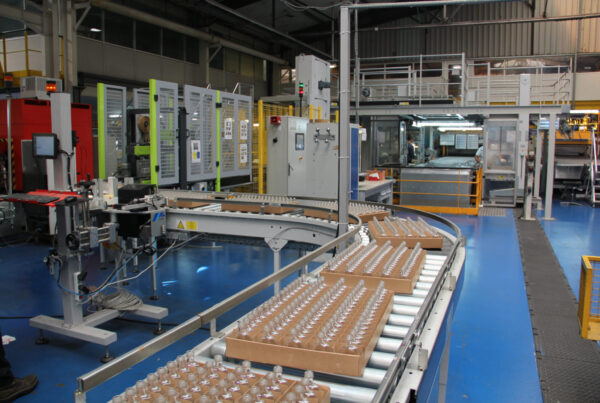
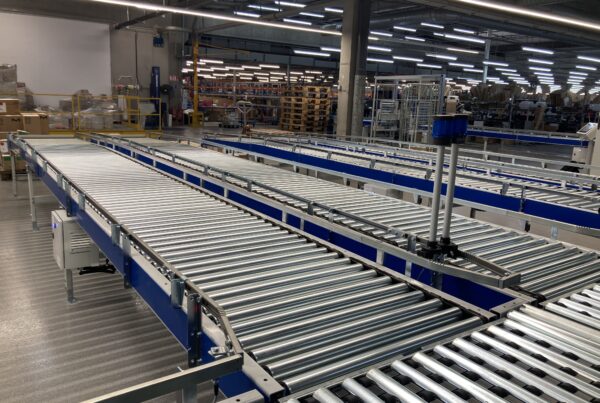
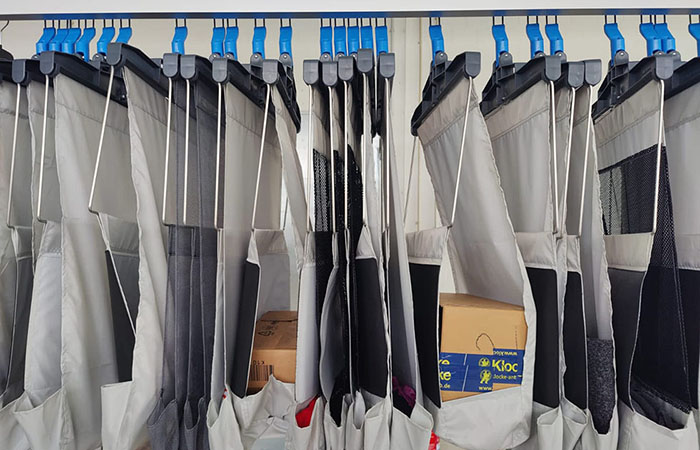
Overhead conveyors and Pocket Sorter are particularly suited to the fashion, cosmetics, and retail sectors. By utilizing vertical space, they make it possible to sort, temporarily buffer, and sequence multi-item orders without encroaching on floor space. The result: better utilization of available space and increased processing capacity.
The WCS: The conductor of Micro-Fulfillment
The role of the Warehouse Control System (WCS) is to synchronize conveyors, storage systems, picking stations, and sorting equipment to ensure an optimal flow of goods. It must also be capable of instantly prioritizing urgent orders, balancing workloads, and optimizing the use of every available resource.
This layer of intelligence is essential to fully exploit the potential of an MFC. Open and scalable software solutions exist, such as OpenWCS, offering the necessary flexibility to support evolving logistics needs.

04. The challenges of Micro-Fulfillment: What to anticipate before launching
Behind the promise of an ultra-performing urban warehouse lie several operational and technological challenges that are essential to anticipate to guarantee the project’s success.
01.
Mastering micro-warehouse replenishment
Unlike a traditional warehouse, an MFC operates with limited volumes and therefore requires more frequent replenishment. The challenge is to avoid any stockouts through a well-thought-out fulfillment strategy that organizes inbound flows while considering urban constraints: heavy traffic, access restrictions for heavy goods vehicles, regulated delivery hours, or environmental issues.
02.
Preserving flexibility in the face of activity fluctuations
The volumes processed by a Micro-Fulfillment Center can vary sharply throughout the year. Sales periods, Black Friday, or seasonal peaks put installations under pressure and can quickly reveal the limits of an under-dimensioned system. This is why it is essential to prioritize modular and scalable solutions capable of supporting business growth and absorbing workload fluctuations.
03.
Banking on comprehensive systems integration
The performance of an MFC relies on perfect coordination between software and physical equipment. WMS, WCS, automated storage systems, conveyors, sorters, or picking stations must work together as a cohesive whole. Multiplying vendors and interfaces can quickly create technical silos, complicate maintenance, and limit performance. A global approach led by a single integrator helps secure the project, simplify interfaces, and optimize the facility’s productivity right from its commissioning.
Looking to optimize your urban logistics, densify your order picking areas, or study the feasibility of a Micro-Fulfillment project? The Transitic teams support you in designing and integrating tailor-made solutions adapted to your operational constraints and growth objectives.
About the Author – Adrien Gislain
Adrien Gislain has been working at Transitic as Customer Solutions Manager since 2021. With over 10 years of experience in logistics, both in France and internationally, he is recognized as an expert in Intralogistics 4.0 and robotics.
Subscribe to our newsletter
A concentrated dose of intralogistics! Discover our latest business cases, videos, and news.
Related Articles
#connectedintralogistics
France
96 Bd du Petit Quinquin
CRT 1 – 59812 Lesquin
Tél. : +33 (0)3 20 87 66 96
Germany
Am Scheid 1
57290 Neunkirchen
Tel : +49 2735 6588580
Spain
C/ Velazquez, N. 80 – 5 IZ
28001 Madrid
Tel : +34 673 234 296