The German magazine Materialfluss interviewed Markus Gorlt, director of Transitic Germany, asking him to share his analysis and field experience on the retrofit market in intralogistics. How has retrofit evolved in recent years? What cost-saving levers, particularly on conveyor systems, can be activated? We share the full interview with you here.

01. How has demand for modernization and sustainable solutions evolved in recent years in intralogistics?
The retrofit market is following a solid growth trajectory. We anticipate an average annual growth of around 10% over the next ten years. This momentum is driven by increased requirements in terms of energy efficiency, sustainability, and investment security.
Companies are now adopting a clear strategy: modernizing existing installations rather than systematically replacing them. The focus is on streamlining, performance improvement, and flexibility. The goal is to upgrade systems so they can absorb future logistical developments without immediately requiring heavy investment.
Whether retrofitting an isolated system or modernizing a warehouse as a whole, the watchword is long-term sustainability, going beyond purely technical considerations.
02. What are clients’ expectations of Transitic as an integrator today, compared to five years ago?
Expectations have evolved significantly, both technologically and strategically. Clients are no longer simply looking for a functional solution, but for scalable, data-driven architectures that guarantee their long-term independence.
Five years ago, projects often focused on one-off modernization actions. Today, it is about comprehensive transformations: real-time data access, modularity, advanced IT integration, and clear visibility on return on investment.
Clients also expect neutral advice. They favour solutions tailored to their processes, independent of manufacturers or proprietary systems. This is precisely where we stand apart: as a strategic intralogistics partner and integrator, rather than a mere executor.
03. In what way does the ability to modernize independently of manufacturers constitute a differentiating advantage?
Transitic is not tied to any manufacturer, which allows us to select the best-performing technologies on the market. Our teams have interdisciplinary expertise and know how to integrate heterogeneous systems within a unified architecture, driven by our Open WCS software, which is manufacturer-independent.
This technological independence offers concrete benefits: freedom of choice, investment security, and the ability to evolve existing systems without depending on a single supplier.
It also brings us great agility: innovations can be integrated at the right moment, according to strategic needs, rather than according to a third party’s roadmap.

04. What are the main obstacles encountered in retrofit projects and how can they be overcome?
The challenges are often recurring: heterogeneity of installations with incompatible protocols, insufficient documentation, lack of usable data, and the need to intervene without interrupting operations.
The interfaces between old and new systems are particularly sensitive.
The key lies in a structured approach. Every project begins with a comprehensive technical audit to precisely assess the existing setup, identify risks, and prioritize actions.
Implementation then takes place in stages, in order to maintain operational continuity. Furthermore, project management is decisive: experienced oversight and close coordination between IT, maintenance, and operations are essential.
05. How quickly is a retrofit project recouped compared to a new installation?
In intralogistics, retrofit generally offers a significantly faster return on investment than a new installation. It averages between two and six years, compared to five to twelve years for a new installation.
This is explained by lower investment costs — often between 30 and 60% of those of a new project — as well as by operational continuity, which limits losses related to downtime.
That said, a new installation may be necessary when existing systems reach their technical or capacity limits. Retrofit is not a doctrine, but a strategic option to be assessed objectively.
06. Which components of conveyor systems offer the greatest energy-saving potential?
The main gains are to be found at the level of motors and drive systems. The use of modern motors combined with variable frequency drives can reduce energy consumption by 30 to 50%.
Another important lever is zone-based control: motorized roller conveyors only activate the segments actually in use, generating significant savings, particularly in the case of variable flows. Intelligent monitoring systems also make it possible to dynamically adjust speeds or automatically switch to standby mode.
Finally, mechanical maintenance is often underestimated: wear and poor adjustments increase friction and therefore energy consumption.
07. What role does digitalization play in the sustainable optimization of processes?
Digitalization is a central lever. Without reliable real-time data, it is impossible to effectively optimize energy consumption, performance, or breakdown risks.
Networking control systems, sensors, and IT solutions provides complete visibility over flows. This data enables informed decisions, continuous performance improvement, and the targeted deployment of predictive maintenance.
Sustainability therefore rests not only on more efficient technologies, but also on measurable management capability. Digitalization transforms a logic of one-off actions into a continuous improvement approach.
08. What service models does Transitic offer to guarantee the long-term maintenance of modernized systems?
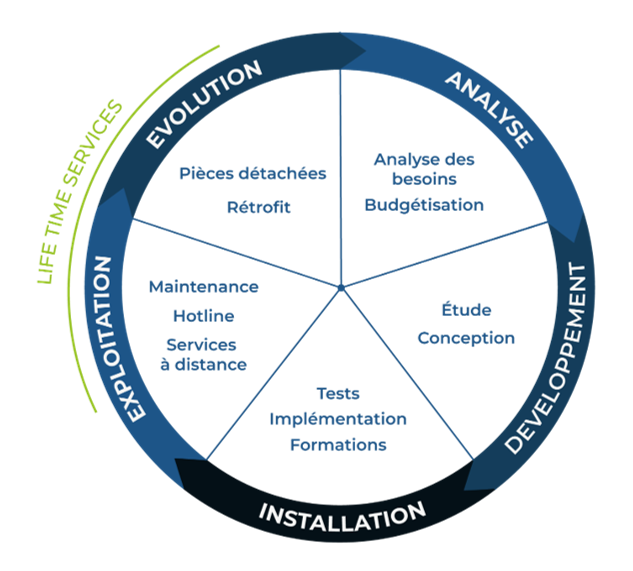
Our approach goes well beyond reactive maintenance. It is built around three complementary pillars.
- First, preventive maintenance: regular inspections, servicing plans, training, and monitoring tools ensure continuous oversight with real-time alerts.
- Next, predictive maintenance: through connected sensors and data analysis, potential failures are detected in advance, thereby avoiding unplanned downtime.
- Finally, evolutionary maintenance: targeted modernizations, spare parts management, and obsolescence anticipation guarantee the performance and longevity of installations.
These services are grouped into tailored contracts, adapted to each client’s specific needs, with a clear objective: maximizing availability while ensuring cost control.
About the author – Markus Gorlt
Markus Gorlt has been director of Transitic Systems GmbH since 2024. Passionate about innovation and new technologies, he has been working in the world of intralogistics for 17 years.
#connectedintralogistics
France
96 Bd du Petit Quinquin
CRT 1 – 59812 Lesquin
Tél. : +33 (0)3 20 87 66 96
Germany
Am Scheid 1
57290 Neunkirchen
Tel : +49 2735 6588580
Spain
C/ Velazquez, N. 80 – 5 IZ
28001 Madrid
Tel : +34 673 234 296