AI in the Warehouse: Where Should an SME begin?
Summary of the article
AI in warehousing isn’t reserved for giants: it integrates directly with the existing tools of SMEs. It optimizes inventory management, maintenance, order picking, and quality control. A targeted use case guarantees a fast return on investment, within 6 to 12 months. Accessible without experts or full robotization, this approach delivers immediately measurable results.
Artificial intelligence in the warehouse is generating a massive wave of interest. However, it is most often illustrated by spectacular, futuristic examples: vast fulfillment centers covering hundreds of thousands of square feet, astronomical budgets, and dedicated teams of data scientists. These representations lead many to believe that AI is strictly reserved for multinational logistics giants.
Yet, the reality on the ground tells a completely different story. According to global technology adoption reports, the proportion of small and medium-sized Enterprises (SMEs) leveraging generative AI skyrocketed from 31% to 55% between late 2024 and late 2025. This shift highlights how deeply integrated AI has become within the broader economy. Interestingly, the logistics sector has historically lagged behind, with fewer than 10% to 15% of SME warehouses actively using AI in 2025. Consequently, forward-thinking SMEs that embrace this technology today, focusing on highly targeted use cases and a phased implementation strategy, are gaining a massive competitive edge over a market that is still hesitant to make the leap.
01.What does AI in the warehouse actually mean?
Before diving in, let’s clarify three core concepts that are frequently brought up but often confused:
Predictive AI
This technology analyzes historical data (past sales, inventory movements, machine error logs) to forecast likely future events. For example, it allows you to anticipate stockouts before they happen or flag an asset that poses a high risk of breaking down in the coming weeks.
Generative AI
This branch produces text or natural language responses. In a warehouse setting, it usually acts as a virtual assistant capable of answering simple prompts (e.g., “How many pallets of SKU X do we have ready?”) without requiring the operator to navigate complex software dashboards.
Computer Vision
This pairs industrial cameras with an algorithm capable of recognizing shapes, reading labels, or spotting visual defects. It functions much like the human eye but works continuously, flawlessly, and without fatigue.
The most critical takeaway for an SME is this: Artificial intelligence is not a standalone software suite you buy on its own. Instead, it is increasingly being integrated directly into existing Warehouse Management Systems (WMS), Warehouse Control Systems (WCS), or machinery already on the floor.
02. 5 practical, budget-friendly AI applications for SMEs
01. Demand forecasting and inventory protection
This is often the easiest entry point for an SME. An algorithm crunches historical sales figures, seasonality, and even external data points (like weather patterns or commercial calendars) to fine-tune your inventory needs and trigger replenishment at the perfect time. In practice, this minimizes both costly stockouts (lost sales) and overstocking (tied-up capital and wasted square footage).

02. Spotting equipment failures before they happen
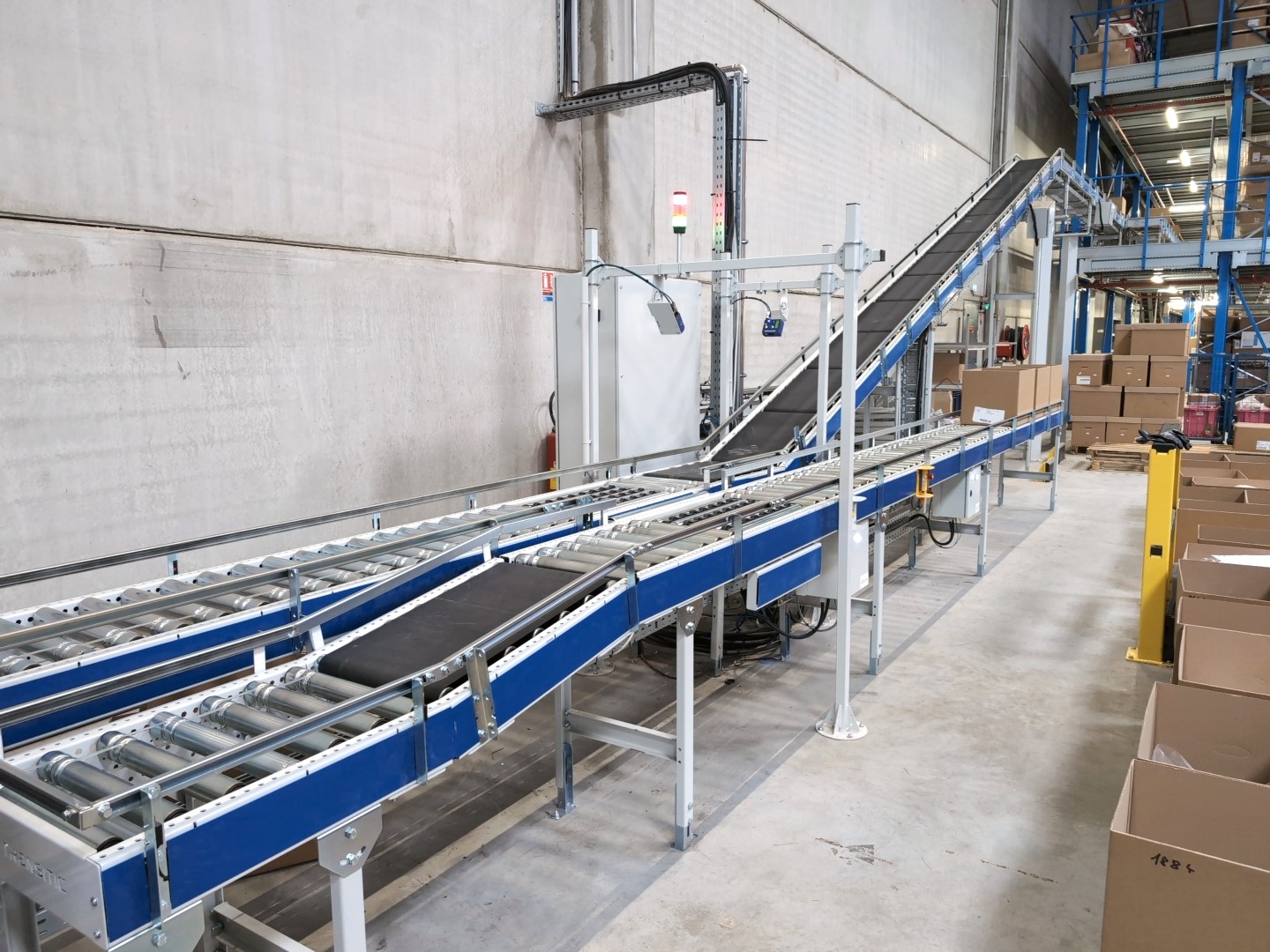
Predictive maintenance utilizes industrial sensors mounted on hardware, such as conveyors, sorters, or lift trucks to detect weak warning signs like unusual vibrations, minor overheating, or performance drops before they spiral into a catastrophic shutdown. For an SME, the benefits are clear: fewer unplanned stoppages, fewer emergency repair costs, and far more structured maintenance schedules. (Read our guide on Predictive Maintenance)
03. Streamlining order picking operations
When it comes to order picking, AI can instantly optimize picker routes, automatically prioritize rush orders, or batch waves of tasks together to eliminate unnecessary walking time. Some advanced systems go even further by dynamically balancing workloads across multiple operators based on real-time availability. The beauty of this optimization is that it doesn’t require overhauling your entire operation; it simply layers onto your existing processes.

04.Querying your warehouse in natural language
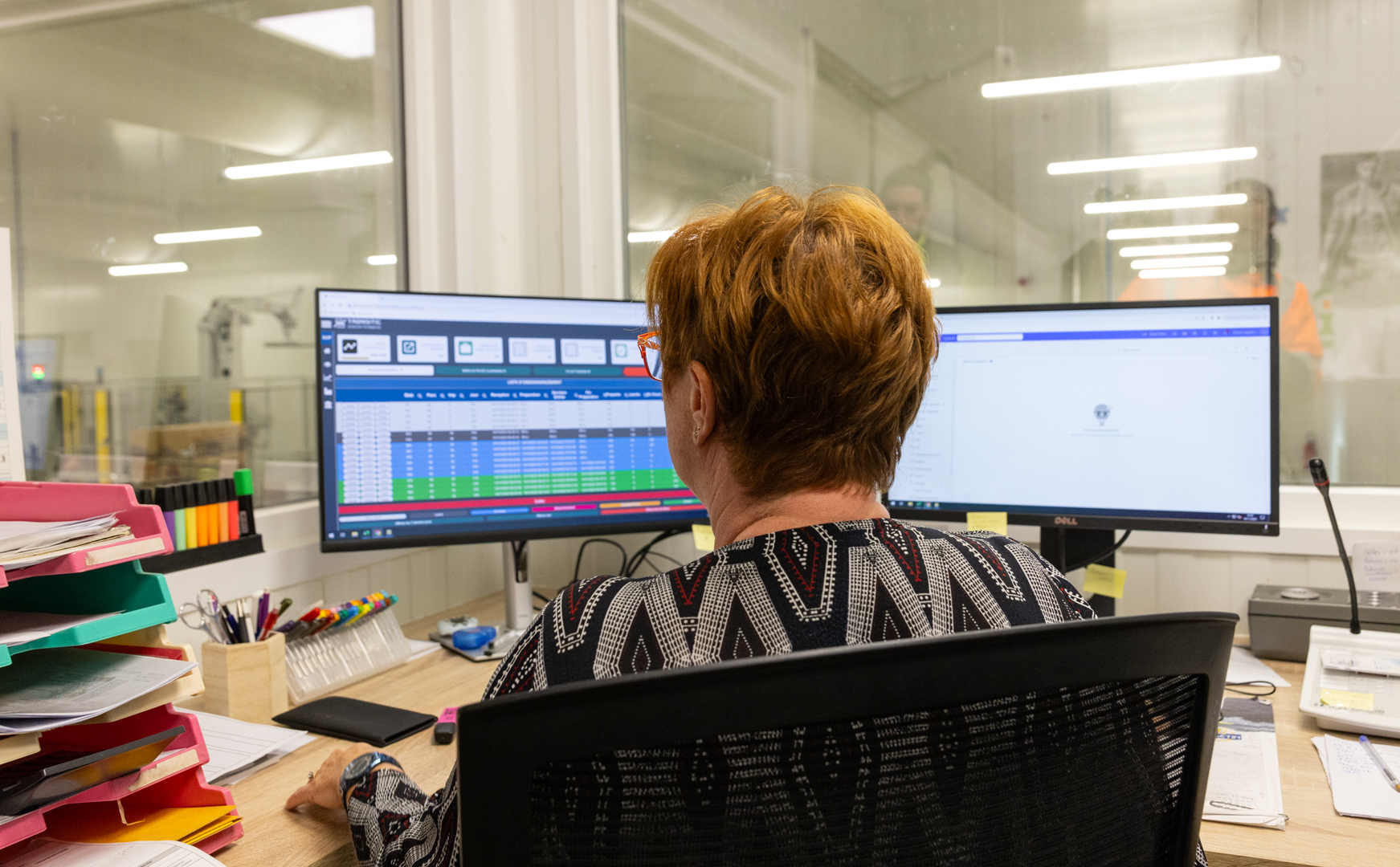
A growing number of supply chain software providers are embedding conversational assistants into their platforms. Instead of building a custom report or toggling between multiple screens, an operations manager can simply type or speak a question and get an immediate answer in the form of a number, a chart, or a checklist. For SMEs without a dedicated IT department, this is the most seamless way to adopt AI because it requires zero technical training. This is one of the tangible benefits of a fully synchronized ecosystem between your material handling equipment and your Management & Automation Software.
05. Sorting and quality control via Computer Vision
Along your sorting lines, a camera paired with an AI algorithm can read partially damaged barcodes, verify that a parcel perfectly matches the order profile, or flag packing defects before the shipment loads onto the truck. Automated quality control drastically lowers shipping errors, a major hidden cost for SMEs when you factor in reverse logistics, re-shipping fees, and customer churn.

03. How to successfully integrate AI into your warehouse
For an SME, the break-even point for an initial AI project is remarkably fast, typically sitting between 6 and 12 months (compared to 12 to 18 months for enterprise-level companies, which must navigate far more fragmented legacy systems).
The ideal strategy for an SME is rarely a sweeping, cross-departmental AI overhaul. Instead, the smartest route is to select one specific, measurable bottleneck, such as recurring stockouts on key SKUs, frequent conveyor breakdowns, or sorting errors and address it using an out-of-the-box module or a plug-and-play upgrade to your current setup.
This step-by-step logic aligns perfectly with the principles we outline in our practical guide to Warehouse Automation for SMEs: you don’t need to change everything overnight. This is also the core philosophy behind retrofitting and modernizing existing systems. It allows you to add intelligent capabilities (like smart sensors or predictive software modules) to fully amortized equipment rather than scrapping your infrastructure and starting from scratch.
04. 3 warehouse AI myths to leave behind
01.
“AI requires a 100% robotized warehouse.”
False
The vast majority of AI use cases are software-driven layers that easily integrate into your current layout, not multi-million dollar robotics overhauls.
02.
“We need an in-house team of data scientists.”
False
Today’s tools, whether they are inventory forecasting modules or conversational plug-ins for your WCS, are built to be entirely user-friendly for everyday warehouse teams.
03.
“The results are unclear and impossible to measure.”
False
The data proves otherwise. Drop in stockout rates, reduced picking times, and avoided asset downtimes are concrete, highly measurable metrics visible from the very first months of deployment.
About the Author – Mikaël Jaraszkiewicz
Mikaël Jaraszkiewicz has been working at Transitic for nearly 10 years. He spent 12 years at La Redoute before joining Transitic as WCS Project Manager, then as Industrial IT Manager.
#connectedintralogistics
France
96 Bd du Petit Quinquin
CRT 1 – 59812 Lesquin
Tél. : +33 (0)3 20 87 66 96
Germany
Am Scheid 1
57290 Neunkirchen
Tel : +49 2735 6588580
Spain
C/ Velazquez, N. 80 – 5 IZ
28001 Madrid
Tel : +34 673 234 296