
Choosing the right conveyor for your industry - Complete guide
Transitic offers a wide range of conveyors to equip your warehouse, enhance your productivity, and optimize your storage space.
Choosing a logistics conveyor tailored to your business requires considering several criteria: the nature of the products to be handled, their weight and dimensions, the required throughput, the flow route, and the warehouse layout. Roller, belt, overhead, or pallet conveyors: each technology meets specific needs. Discover the key factors to evaluate in order to select a conveying solution aligned with your operational flows and constraints.
Based on the specific requirements of your industry, we offer a wide range of automated conveyor systems, including:
- Motorized conveyors for fast and smooth transport of loads.
- Gravity or motorized roller conveyors for the flow of pallets, bins, or cartons.
- Overhead conveyors suited for constrained environments or suspended production processes.
- Pallet conveyors designed for the transfer of heavy or bulky loads.
Each solution is designed to integrate seamlessly into your supply chain, taking into account the characteristics of your products (dimensions, weight, fragility) and the requirements of your environment. Thanks to advancements in automation and intelligent control technologies (WMS and WCS software, automated sorting systems), it is now possible to optimize the layout of any type of logistics warehouse, even in complex settings:
- Limited spaces or multi-level warehouses.
- Need for continuous flow between storage, production, and shipping areas.
- Combination of traditional storage and automated conveyor systems (hybrid systems).
- Need for flexibility to adapt to changing volumes or product types.
Our teams design modular, scalable, and customized solutions based on an in-depth analysis of your logistics flows, operational constraints, and performance objectives. We support you from defining your needs to installation, commissioning, and maintenance, ensuring reliable and long-lasting systems to support your growth.
01. How to choose a conveyor for your warehouse?
Selecting a conveying system depends primarily on the goods to be transported and the organization of flow within the warehouse. Several criteria must be evaluated before determining the equipment and its level of automation:
Nature of the loads
Cartons, bins, pallets, garments on hangers, industrial parts, or flexible packaging.
Weight and dimensions
Heavy loads require a pallet conveyor or a reinforced system, while a belt conveyor handles lightweight or unstable products more easily.
Required throughput
An occasional flow can be handled with a gravity conveyor, while high-volume activity generally requires a powered and automated system.
Flow route
Straight lines, curves, elevation changes, accumulation, sorting, or workstation feeding.
Building layout
Available floor space, ceiling height, presence of mezzanines, and movement of operators or material handling equipment.
Industry-specific constraints
Hygiene, traceability, product fragility, specific temperatures, or safety requirements.
A flow analysis then allows for proper network sizing, identification of potential bottlenecks, and determination of the most suitable technologies.
Which conveyor to choose for your industry?
| Industry | Main flows handled | Suitable solutions | Main constraints |
|---|---|---|---|
| E-commerce & Retail | Cartons, totes, parcels, and single items | Roller conveyor, belt conveyor, Pocket Sorter, and expandable conveyor | Activity peaks, format diversity, and omnichannel fulfillment |
| Contract Logistics & 3PL | Multi-client flows, cartons, and parcels | Powered conveyor network, expandable conveyor, vertical conveyor, and sorting system | Fluctuating volumes, flexibility, and managing multiple SKUs |
| Fashion & Apparel | Garments on hangers, accessories, and returns | Power & Free conveyor, overhead gravity conveyor, and Pocket Sorter | Item-level processing, sequencing, and dynamic storage |
| Pharmaceuticals | Cartons, totes, and sensitive products | Roller conveyor, belt conveyor, and automated sorting system | Traceability, product care, and hygiene |
| Food & Beverage | Packaged products, totes, and cartons | Belt conveyor, stainless steel roller conveyor, and overhead conveyor | Cleaning, hygiene, humidity, and controlled temperatures |
| Automotive & Manufacturing | Parts, containers, and heavy loads | Monorail conveyor, pallet conveyor, and trolley system | Heavy payloads, workstation feeding, and production line synchronization |
| Postal & Express Delivery | Variable size parcels | Roller conveyor, belt conveyor, and diverter sorter | High throughput, barcode scanning, and dispatch routing |
02. The main types of floor conveyors
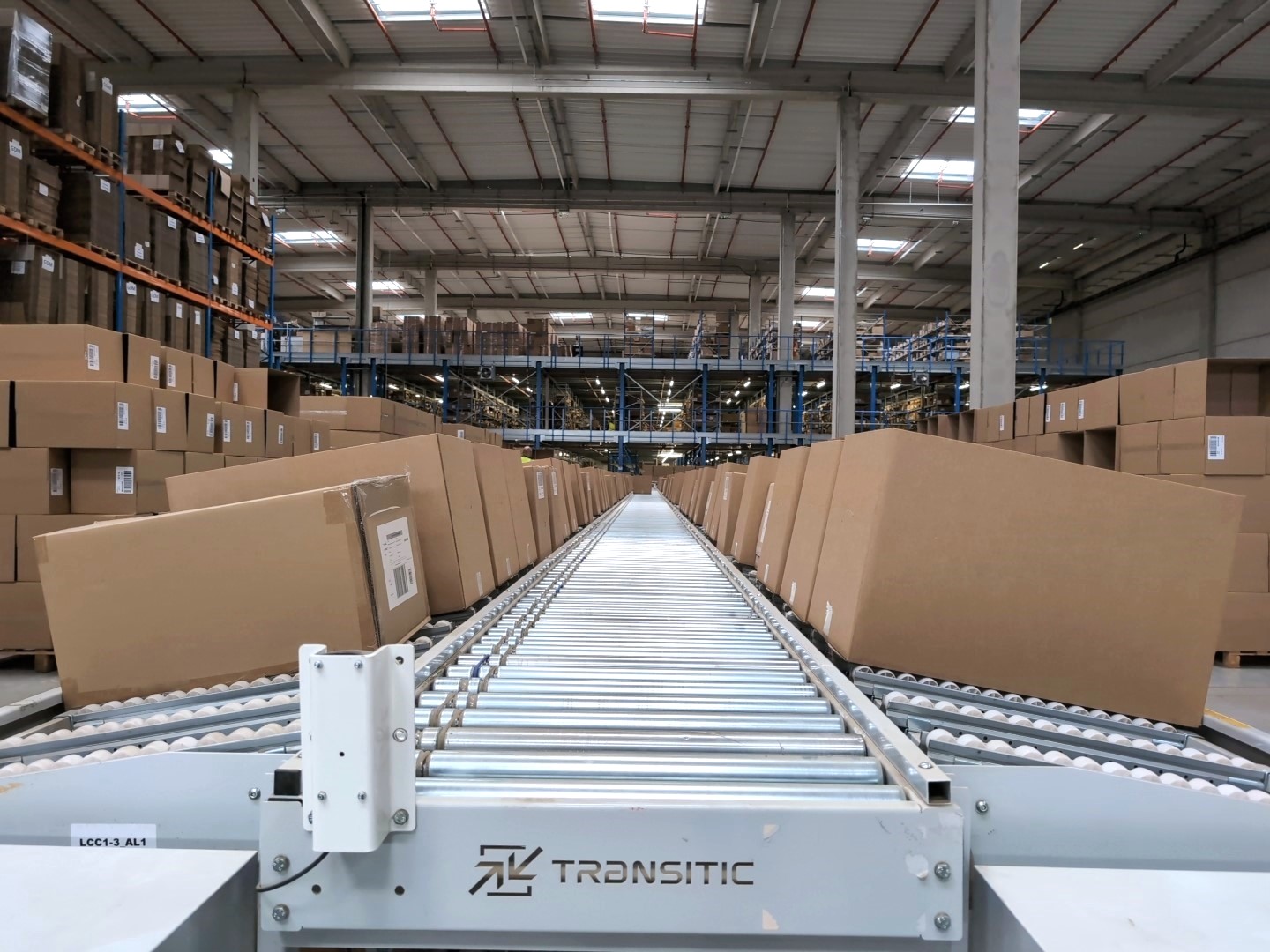
Roller conveyor
The roller conveyor is a central component in intralogistics flow management, known for its robustness, ease of integration, and versatility. Made from steel, it is capable of transporting cartons, bins, or parcels of varying sizes and weights at a sustained pace. It can be either motorized (with rollers driven by belts or chains) or gravity-based, depending on the specific constraints of the warehouse.
This type of conveyor is particularly well-suited for:
- Automated sorting and routing of parcels.
- Feeding or unloading of order picking stations.
- Optimization of transit zones between production and shipping.
Its modular design allows for easy expansion of the system. In addition to simplified maintenance, it offers a fast return on investment.
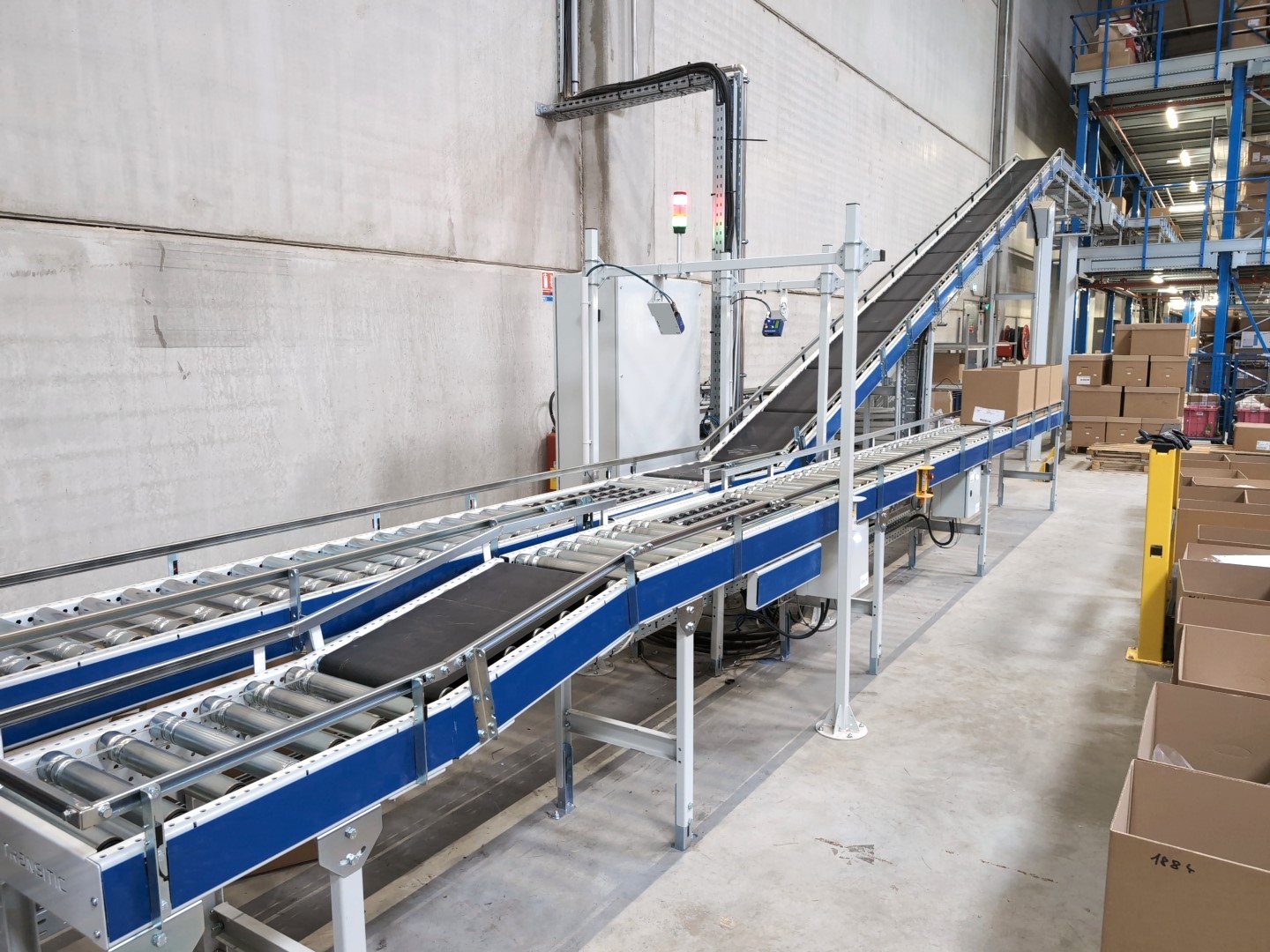
Belt conveyor
The belt conveyor is a motorized solution ideal for transporting lightweight, unstable, or fragile products such as sachets, bottles, electronic components, or flexible packaging. The belt provides a continuous contact surface, preventing shocks and tipping. It can be installed on straight lines or inclined sections.
It is recommended for:
- Packaging or packing lines.
- Inspection or buffer zones that may require occasional slowdowns.
- Flows requiring precise speed and steady movement.
Variants are available based on product specifications: smooth belts, high-grip belts, antistatic belts, or belts designed for the food industry, among others.
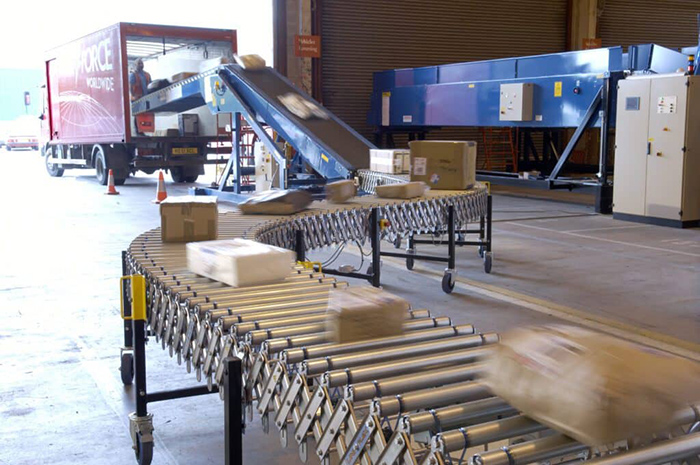
Telescopic conveyor
The extendable conveyor, also known as a telescopic conveyor, provides true operational flexibility. It allows for rapid deployment based on operational needs.
This type of conveyor is used for:
- Facilitating direct loading and unloading from trucks or containers.
- Handling temporary peaks in activity thanks to its mobility and extendable capabilities.
- Establishing a connection between distant equipment.
Available in motorized or gravity versions, with rollers or belts, it can be equipped with side guides, integrated elevators, or sensors to enhance flow efficiency.
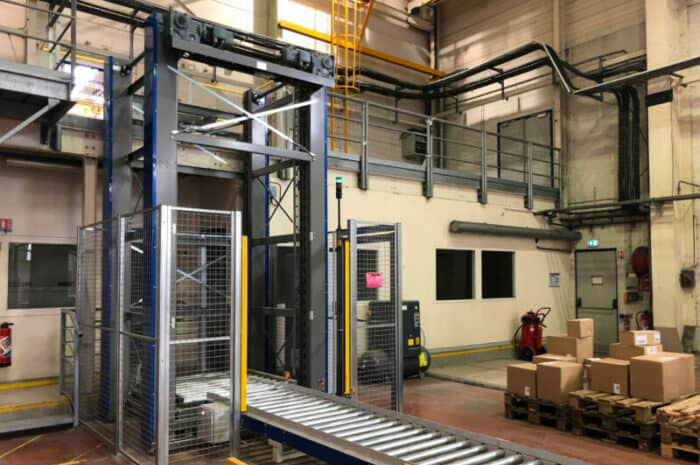
Lift conveyor
The vertical conveyor, also known as a pallet elevator or lift, is designed for automated transfer of pallets or cartons between multiple levels and is ideal for multi-story warehouses. Its motorized lifting system ensures a high throughput while guaranteeing safety and continuity of flow.
Its main advantages are as follows:
- Optimization of multi-level logistics spaces.
- Easily integrable into conveyor networks.
- High load capacity and safe operation.
- Connected to other automated systems via WMS and WCS.
03. The main types of overhead conveyors
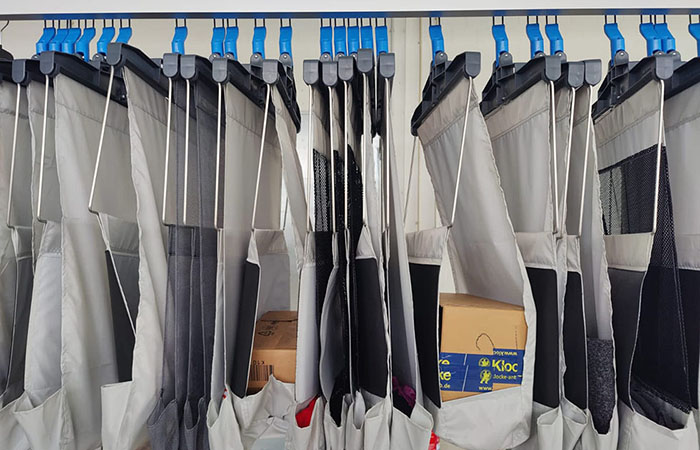
Pocket Sorter
It is a suspended system designed for the transport, storage, and automatic sorting of items placed in pouches on hangers. This all-in-one solution significantly optimizes order preparation, reduces human intervention, and ensures a high level of productivity.
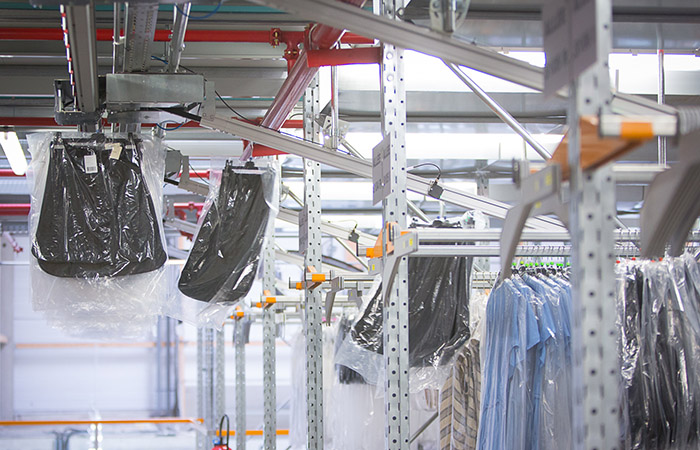
Gravity conveyor
It is an overhead conveyor set at a slight incline to allow goods to slide by their own gravity. Economical and efficient, the gravity conveyor minimizes floor space usage and reduces the handling of goods by operators.
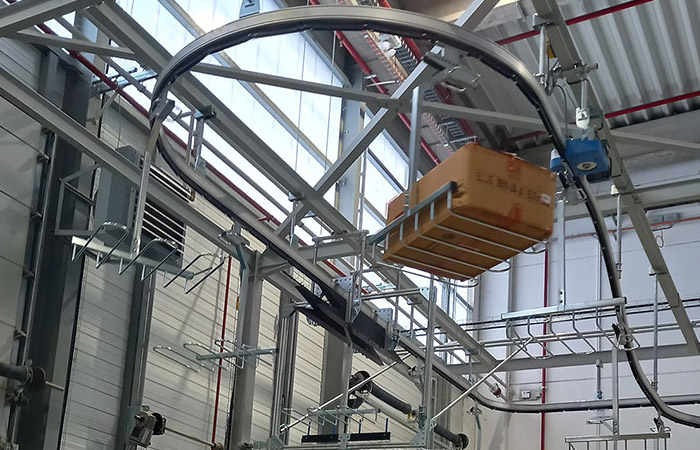
Gondola conveyor
It is designed for handling very light loads such as empty cartons. It is a modular system for replenishing or evacuating workstations. The gondola conveyor thus reduces operators’ movements and improves productivity.
Monorail conveyor
The monorail overhead conveyor is a motorised, modular system that can be adapted to any type of industry. For the textile industry, the ratchet conveyor can be used to transport and sort garments on hangers. For the automotive industry, the trolley system can support heavy loads. Equipped with chains or brushes, the monorail conveyor is extremely resistant and optimises logistics flows to the maximum.
Discover Our Expertise in Conveyor Systems
Learn more about our conveyors
#connectedintralogistics
France
Transitic Systems SAS
96 Bd du Petit Quinquin
CRT 1 – 59812 Lesquin
Tél. : +33 (0)3 20 87 66 96
96 Bd du Petit Quinquin
CRT 1 – 59812 Lesquin
Tél. : +33 (0)3 20 87 66 96
Germany
Transitic Systems GmbH
Am Scheid 1
57290 Neunkirchen
Tel : +49 2735 6588580
Am Scheid 1
57290 Neunkirchen
Tel : +49 2735 6588580
Spain
Transitic SL
C/ Velazquez, N. 80 – 5 IZ
28001 Madrid
Tel : +34 673 234 296
C/ Velazquez, N. 80 – 5 IZ
28001 Madrid
Tel : +34 673 234 296


